





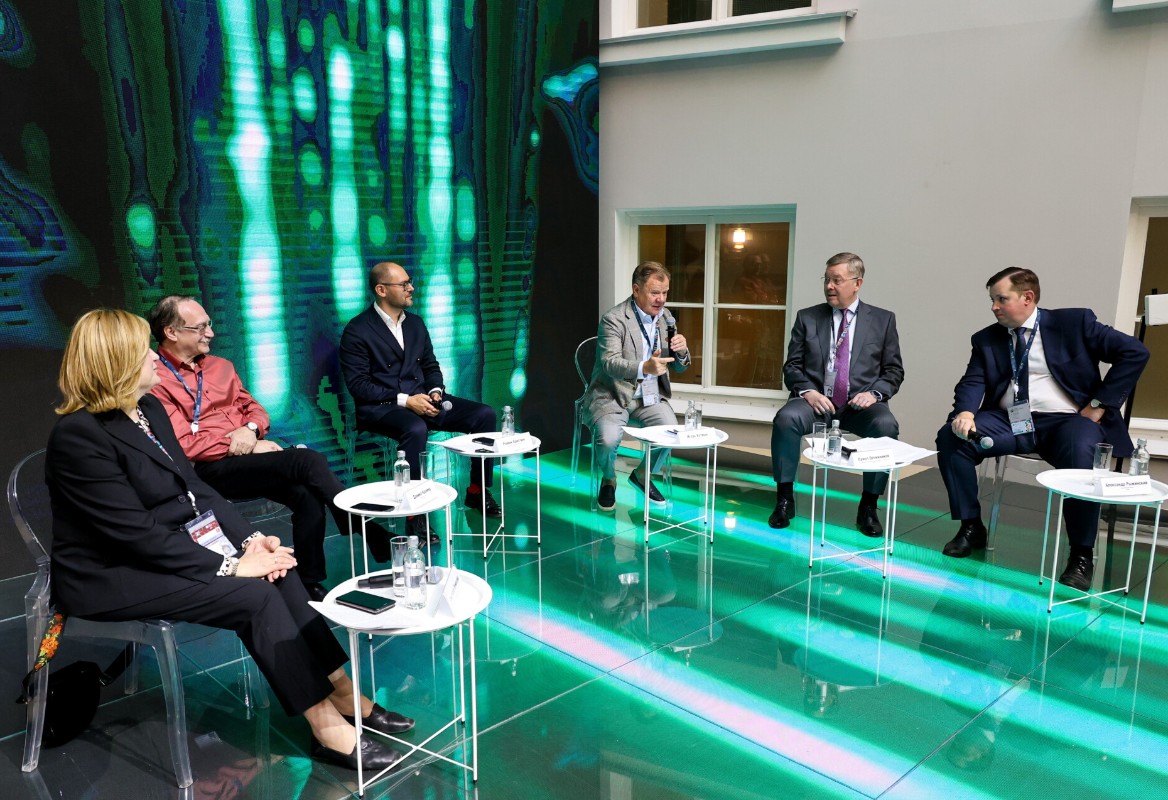
At the XI St. Petersburg International United Cultures Forum, a panel discussion titled "Popular and Jazz Music Education in Russia: Challenges and Prospects" was held.
Those taking part included People’s Artist of Russia Igor Butman, People’s Artist of Russia Daniil Kramer, Head of the Department of Regional Policy, Education and Project Management at the Ministry of Culture of Russia Svetlana Ermakova, Rector of the Gnessin Russian Academy of Music Alexander Ryzhinsky, and Honored Artist of Russia Pavel Ovchinnikov, First Deputy Director of the Academy of Jazz. The discussion was moderated by Roman Khristyuk, Executive Director of the Igor Butman Foundation. Speakers examined the new challenges facing jazz education and the arts in Russia.
People’s Artist of Russia and musician Igor Butman stated the need to create an Academy of Contemporary Music in Russia. Participants in the discussion expanded on the topic, discussing updates to training standards and the possibility of creating a conservatory for non‑academic music.
"I can see, and we all can see, the need for an educational institution designed entirely for non‑academic music." A flagship that could give momentum to the regions, to music schools, art schools and colleges. This is needed not only for jazz but for any industry that is not classical. "That is why we would like to create a school that would train musicians of popular and rock music, studying all the styles that are considered non‑academic," said Igor Butman.
The forum participants also discussed the role of musical culture in the development of the arts and of young people’s moral and spiritual values. Daniil Kramer noted that art shapes life as a whole.
"I have never hidden that I regard culture as a global factor in human life. All of human history proves it. Even cave people painted on walls, spending their time and resources on images and beauty instead of procuring a mammoth trunk. There is a primitive pop culture that, in my view, has a dreadful impact.
"Chewing‑gum" with two stomps and one clap, on which whole generations grow up, trivializes the brain and feelings. Pop culture in its worst manifestation, in my view, has a direct bearing on the upbringing of the so‑called generation of consumers. As for jazz, it is a totally different culture. I continue to insist that children’s IQ directly depends on the culture we feed them," concluded Daniil Kramer.
In addition, the speakers outlined challenges the popular and jazz training system faces in preparing professionals. They noted a shortage of prepared applicants, qualified teachers, and teaching materials.
"There are very few theorists. No one wants to do arranging. There are also few specialists who teach the core subjects. Overall, there is a problem: low qualifications among some teachers who lack adequate training in jazz harmony, jazz solfeggio, and especially improvisation. There is also no specialized teaching and methodological association, perhaps even a nationwide center for popular and jazz music education, that would bring together the very best. This leads to problems in textbooks and teaching methods. Where are we supposed to get them? We need to write them ourselves, right? And we do have such people," said Pavel Ovchinnikov.